Inside a factory run by four AI agents
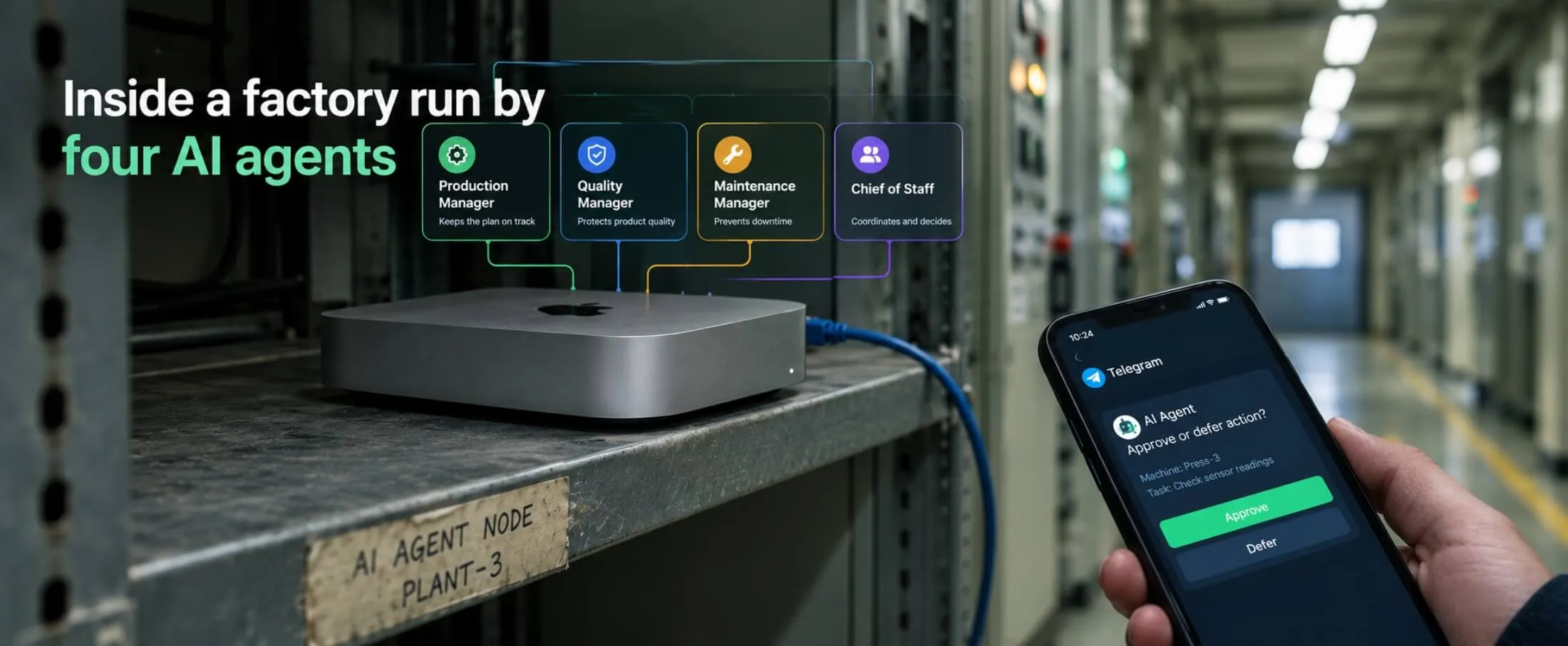
The system runs on an M2 Mac Mini sitting on a shelf. Not a cloud region, not a rack — a Mac Mini. Four AI agents share that machine: a Production Manager, a Quality Manager, a Maintenance Manager, and a Chief of Staff sitting above the three of them. They coordinate with each other and with people over Telegram, because Telegram was already open on every phone in the plant.
I am writing this up because most multi-agent content is either a vendor diagram or a research paper. Very little of it tells you what the system actually does at 7 a.m. on a Tuesday, or what broke on the way there.
Some context on where this sits. Deloitte’s Tech Trends 2026 work reports that only 11% of organisations are actively using agentic systems in production, and just 14% have solutions merely ready to deploy, while 42% are still writing the roadmap. Gartner expects more than 40% of agentic AI projects to be cancelled by the end of 2027. So read what follows as a note from a small minority, not as a template.
Why four agents instead of one
The obvious design is one assistant with access to everything. We tried that first and it was worse, for a boring reason: a single agent holding twenty tools and one enormous instruction set makes confident mistakes in domains it only half understands. It would answer a scrap-rate question using yesterday’s production plan, because both happened to be in context.
Splitting by role fixed most of that, and it mirrors the org chart, which matters more than it sounds. Each agent gets:
- A narrow brief — one function, written in the language the plant already uses.
- Its own tool permissions — the Quality agent can read the production log but cannot change the schedule.
- A named human counterpart who approves anything consequential.
The Chief of Staff agent is the one people under-build. It does no plant work at all. It routes questions, holds the shared picture of the day, chases the other three for status, and decides what is worth putting in front of a human. Without it, the other agents either go silent or all talk at once.
The research supports splitting carefully rather than just splitting. The NeurIPS 2025 paper “Why Do Multi-Agent LLM Systems Fail?” analysed more than 1,600 annotated traces across seven multi-agent frameworks and catalogued 14 distinct failure modes. One of its three top-level categories is inter-agent misalignment: agents withholding information, talking past each other, dropping a task each assumed the other had picked up. We have seen every one of those.
A Tuesday morning, step by step
Here is one pattern, start to finish.
- 06:50 — the Maintenance agent reads overnight data. It pulls machine run-hours and alarm history from the local historian and PLC tags. One press shows a vibration alarm that cleared itself twice during the night.
- 06:55 — it checks history, not just the alarm. The same alarm pattern appeared before an unplanned stop some weeks earlier. That is in the maintenance log, which is precisely why the log was worth cleaning up first.
- 07:00 — it writes a recommendation, not an action. A Telegram message to the maintenance lead: the machine, the two alarms, the matching earlier incident, and a proposed 40-minute inspection slot. Two buttons — approve, or defer with a reason.
- 07:02 — the Chief of Staff agent sees the proposal and asks Production. A 40-minute stop is a production decision, not only a maintenance one. The Production agent checks the day’s plan and the order book and answers: the slot right after shift change is the cheapest hour to lose today.
- 07:10 — the human approves on his phone. One tap. The inspection goes onto the schedule, the production plan is revised, and the shift supervisor receives the changed plan — not an alert to interpret, but the new plan.
- During the shift — the Quality agent watches the other end. If first-pass yield on that line drifts after the inspection, it flags the correlation to the Chief of Staff. That is how we find out whether the inspection actually helped.
That is the whole mechanism: each agent is narrow, the coordination between them is explicit, and the only step that changes the physical world is a human tapping a button. The agents are not running the factory. They are running the watching and the paperwork around it, which is most of the work and almost none of the risk.
Why that is worth money: Fluke’s 2025 survey of US manufacturers found 55% were hit by unplanned downtime in the previous year, nearly half of them logging six to ten incidents a week, and 45% reporting outages that lasted up to twelve hours. Catching a handful of those a year pays for a Mac Mini several hundred times over.
What broke
The parts nobody puts in the architecture diagram.
Authentication changed under us. We first ran the agents on OAuth-based desktop credentials. When the model provider tightened its rules on third-party agent frameworks, overnight runs began failing silently. We migrated everything to proper API keys. The lesson: an agent that runs unattended needs credentials meant for machines, and somebody has to own a monitor that answers “did last night’s run actually happen?”
The data was worse than anyone admitted. Maintenance logs with free-text machine names, three spellings of the same part, downtime reasons typed at the end of a shift from memory. Rockwell’s 2026 State of Smart Manufacturing report has Indian manufacturers naming data capture and interpretation as their top internal obstacle, at 60% against 37% globally. That matched what we found almost exactly. We spent real weeks on data cleanup before any agent became useful, and nobody budgets for that phase.
Agents are too polite to escalate. Early on, an agent that could not get an answer would quietly produce a plausible one instead of saying “I am blocked.” Fixing it meant making “I don’t know, and here is who should decide” a first-class, rewarded outcome, and giving the Chief of Staff a timeout on every delegated task.
Telegram was both the right choice and a problem. Right, because adoption was instant — nobody has to install anything. A problem, because a chat window is not an audit trail a quality auditor will accept. We now write every agent decision to a local log along with the inputs it saw, and treat the chat as the interface rather than the record.
If you are a plant head starting this
- Pick one function, not four. Maintenance is usually the best first agent: the data already exists, the win is measurable, and nobody’s bonus depends on it.
- Fix the log before you shop for a model. Three months of clean, consistent downtime reasons is worth more than a larger model.
- Make every consequential step a human tap. Approval is not a limitation on the system; it is the thing that makes the system deployable in a plant that gets audited.
- Build the coordinator early. Four agents without a router is a group chat, not a system.
- Decide where the data lives before the first API call. We run these workloads on hardware inside the plant for exactly this reason — shop-floor data never leaves the building, and the agents keep working when the internet does not.
- Instrument the agents the way you instrument machines: uptime, run success rate, cost per run, and a named owner for each.
Takeaways
- Four narrow agents beat one broad one — because of permissions and context, not because of intelligence.
- A coordinator agent stops being optional the moment you have more than two agents.
- The real failure modes are coordination and data quality, not model quality.
- Keep humans on approvals and keep an immutable log. That is what makes the system auditable.
- Small hardware is enough. Ours runs on a Mac Mini on a shelf.
If you are building something similar, I would rather compare notes than pitch you. We are opening the beta for v1 of our on-prem automation platform — the one these agents run on — towards the end of 2026. You can join the waitlist, or book a call and walk me through your plant’s version of this problem.