Why Job Boards Fail in Developing Economies
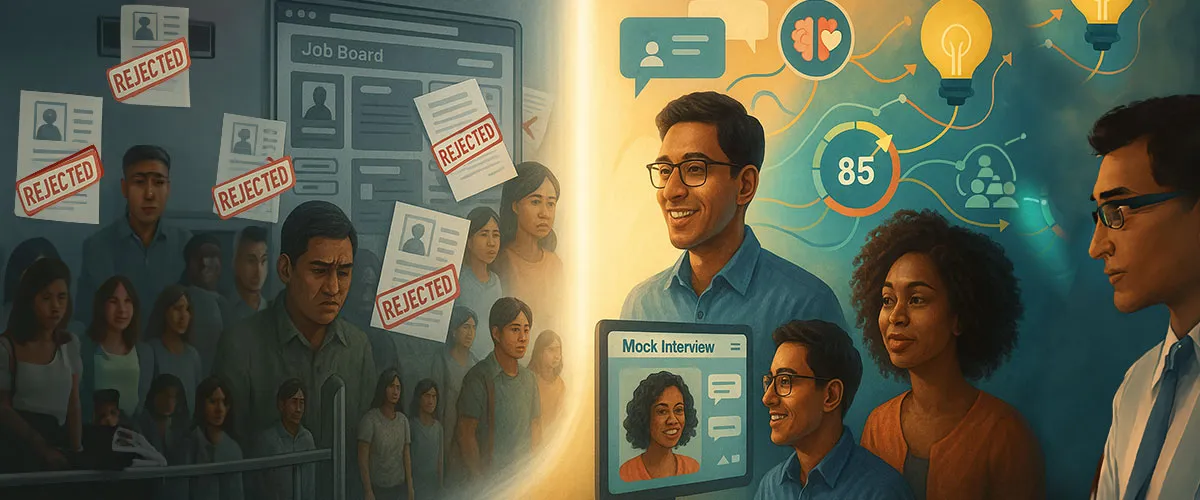
The Broken Promise of Digital Hiring
When job boards first emerged, they were hailed as equalizers—tools that would allow anyone, anywhere, to access opportunity with just a resume and a connection. But over the last decade, that promise has collapsed under its own assumptions.
For job seekers in developing economies, job boards often deliver confusion, rejection, and invisibility—not opportunity.
What looks like scale on the surface hides a deeper disconnect: the systems were never designed with these job seekers in mind.
What the Market Misses
Most platforms are optimized for:
- Credentialed candidates from established regions,
- Roles with predictable experience ladders,
- Recruiters who filter by title, tool, and tenure.
But in many emerging markets,
- Education is nonlinear,
- Experience is informal,
- Cultural context shapes confidence and communication,
- And access to feedback, mentorship, or mock interviews is rare.
The result? Millions of job seekers are excluded by algorithms that were never trained on their reality.
The Limitations of Current Platforms
Several core assumptions drive how job boards operate:
- Skills = Fit
- Resume = Readiness
- Keywords = Capability
But these assumptions collapse when:
- A highly skilled candidate lacks English fluency to “signal” competence,
- A motivated learner is penalized for not having formal internship credentials,
- A team-oriented problem solver is filtered out for missing a few keywords.
Across projects and geographies, we’ve seen that the problem isn’t talent—it’s translation. The hiring system struggles to translate potential into visibility.
Reframing the Problem: Readiness Is Not Just Resume-Deep
In our work designing and advising for employment systems in underserved regions, we’ve encountered a recurring truth: readiness isn’t just about skills—it’s about confidence, clarity, and behavioral alignment.
The core idea we keep returning to is this:
- Fit is dynamic. It’s not just about what someone knows, but how they think, adapt, and grow.
That dimension is missing from almost every major hiring platform.
What’s needed is a more holistic, inclusive model—one that integrates behavior, not just experience.
A New Model of Matching
In models we’ve explored internally, we’ve reimagined job-readiness along three axes:
- Education Parsed and verified automatically—but not over-weighted.
- Skills Contextualized, not just listed. Signals include project-based learning, side work, or self-taught mastery.
- Behavioral Alignment Measured through structured assessments that reflect adaptability, self-motivation, work style, and more.
Together, these dimensions begin to form what some refer to as a JobFit Score—a concept gaining attention in the context of future-of-work systems.
Why This Matters for Developing Economies
In the ecosystems we’ve studied, two major gaps emerge:
- Signaling gap: Candidates may have capability, but lack the means to express it in the formats that platforms reward.
- Preparation gap: There is little structured support for things like mock interviews, feedback, or understanding fit beyond a job title.
Addressing these gaps isn’t just an add-on—it’s foundational to building systems that work in contexts beyond the West.
Behind the Thinking
At Mobifilia, we work on designing future-ready employment systems that center human behavior, inclusive logic, and scalable equity. Our work draws from emerging market realities and rethinks what job readiness could—and should—look like.