Cloud Migration Costs: Why an 11% Higher Bill Was Worth It
Every cloud migration pitch you’ve ever seen has a slide that says “reduce infrastructure costs by 30–40%.”
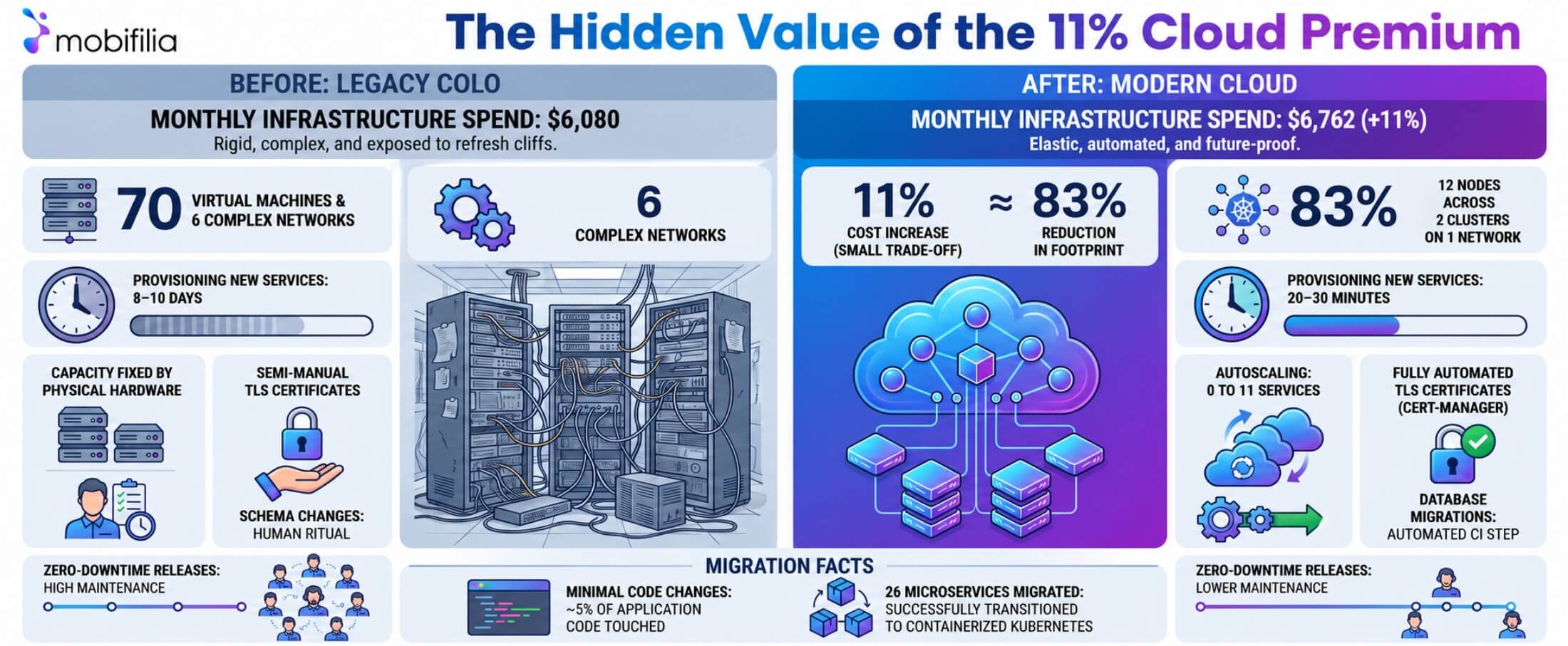
Here are our real numbers. Last year we migrated a live-streaming and social platform — 26 microservices, live video ingest, payments, the works — from a self-hosted colocation facility to Kubernetes on a managed cloud. Their infrastructure bill before: $6,080 per month. After: $6,762 per month. That’s an 11% increase. And if you asked their engineering leadership whether they’d do it again, the answer would be an immediate yes.
If that sounds contradictory, this post is for you — because the monthly invoice is the least interesting number in a migration, and judging one by it is how companies end up making the wrong call in both directions.
What the platform looked like before
The “before” picture will feel familiar to anyone running a platform built in the 2010s: two racks in a Toronto colo on yearly contracts. Ten physical nodes running roughly 70 virtual machines across two clusters. Six separate networks — production, dev, enterprise, management and more — stitched together with three different firewall technologies, all hand-configured, all understood end-to-end by a very small number of people. Self-hosted PostgreSQL with replicas behind HAProxy. Self-hosted caching, object storage, message queues. A streaming media tier handling live RTMP video.
None of it was broken. That’s worth saying clearly: this platform ran with zero infrastructure-related on-call incidents per month, and releases already shipped with zero downtime. The team was competent, and the system was stable.
It was also rigid, opaque to everyone but its builders, and sitting on hardware that was aging toward a refresh bill nobody wanted to sign.
What the invoice comparison hides
The colo bill and the cloud bill are not measuring the same thing. Three things the $6,080 never included:
The next hardware refresh: Blade chassis and storage arrays don’t depreciate politely — they work until the week they don’t, and then you’re writing a five-figure-to-six-figure capex cheque under time pressure. The cloud bill has no refresh cliff hiding behind it. That risk is now the provider’s problem, priced into the monthly rate.
Commitment: The racks came with yearly contracts. The cloud footprint is elastic month to month — the platform can grow, shrink, or restructure without a procurement negotiation.
Engineer attention: This is the big one. The before-state had ~70 VMs and 6 networks worth of patching, firmware, backups, and firewall rules competing for senior engineers’ time. The after-state is 12 nodes in 2 clusters on a single cluster network. That’s an ~83% reduction in the number of machines anyone has to think about — and the engineers who used to think about them now work on the product.
What the extra $682 a month actually bought
Cost parity would already have been a win given the above. But the after-state isn’t the same platform at a similar price — it’s a categorically different platform:
- Provisioning a new service used to take 8–10 days. It now takes 20–30 minutes. A full new environment: 1–2 days. That’s not an optimization; it’s a change in what the engineering organization can attempt.
- Autoscaling went from zero to 11 services. Before, capacity was whatever the fixed VMs provided. Now the API, media, and web tiers scale themselves.
- TLS certificates went from semi-manual to fully automated. An entire category of embarrassing outage — the expired cert — is structurally gone.
- Database schema changes became a gated, automated CI step across 8 services, instead of a human ritual.
- And the things that were already good stayed good: releases still ship with zero downtime, rollbacks still take 2–5 minutes, and infrastructure on-call is still quiet.
The entire migration, incidentally, required touching only about 5% of the application code — but that’s next week’s post.
The honest framework
If you’re evaluating a migration, put away the invoice comparison and ask three questions instead:
- What’s the real all-in cost of staying? Colo bill + amortized refresh capex + contract lock-in + the fully loaded hours your best engineers spend being a hosting company.
- What does the target platform let you attempt that the current one doesn’t? For our client, the honest answer included an AI-powered feature set that simply could not have been built on the old stack (part 5 of this series).
- What’s your key-person risk? If the number of people who fully understand your network can fit in a sedan, you have a problem no invoice line captures.
And to be fair — sometimes the answer is stay put. If your load is flat, your hardware is freshly refreshed, and your platform knowledge is well distributed, a migration may genuinely not pay. A vendor who won’t tell you that is selling something other than engineering.
The bottom line
An 11% higher bill bought: an 83% smaller infrastructure footprint, provisioning measured in minutes instead of weeks, self-scaling services, structural elimination of whole outage categories, zero capex exposure — and an engineering team pointed at the product instead of the plumbing.
That’s the trade. We think it’s a good one. More importantly, our client’s CTO thinks so — with a year of production behind the opinion.
Next week: how 26 services moved to Kubernetes with only 5% of the code changed — the anatomy of a no-rewrite migration.
Mobifilia helps companies move business-critical platforms from self-hosted infrastructure to cloud-native Kubernetes — without rewrites and without fairy tales.
- cloud cost optimization
- cloud migration
- cloud migration costs
- cloud-native infrastructure
- DevOps
- infrastructure modernization
- Kubernetes migration
- managed Kubernetes
- microservices
- platform engineering
Want to know more? Book a free 30-minute consultation
Book a Call03 Aug 2026
Related Posts
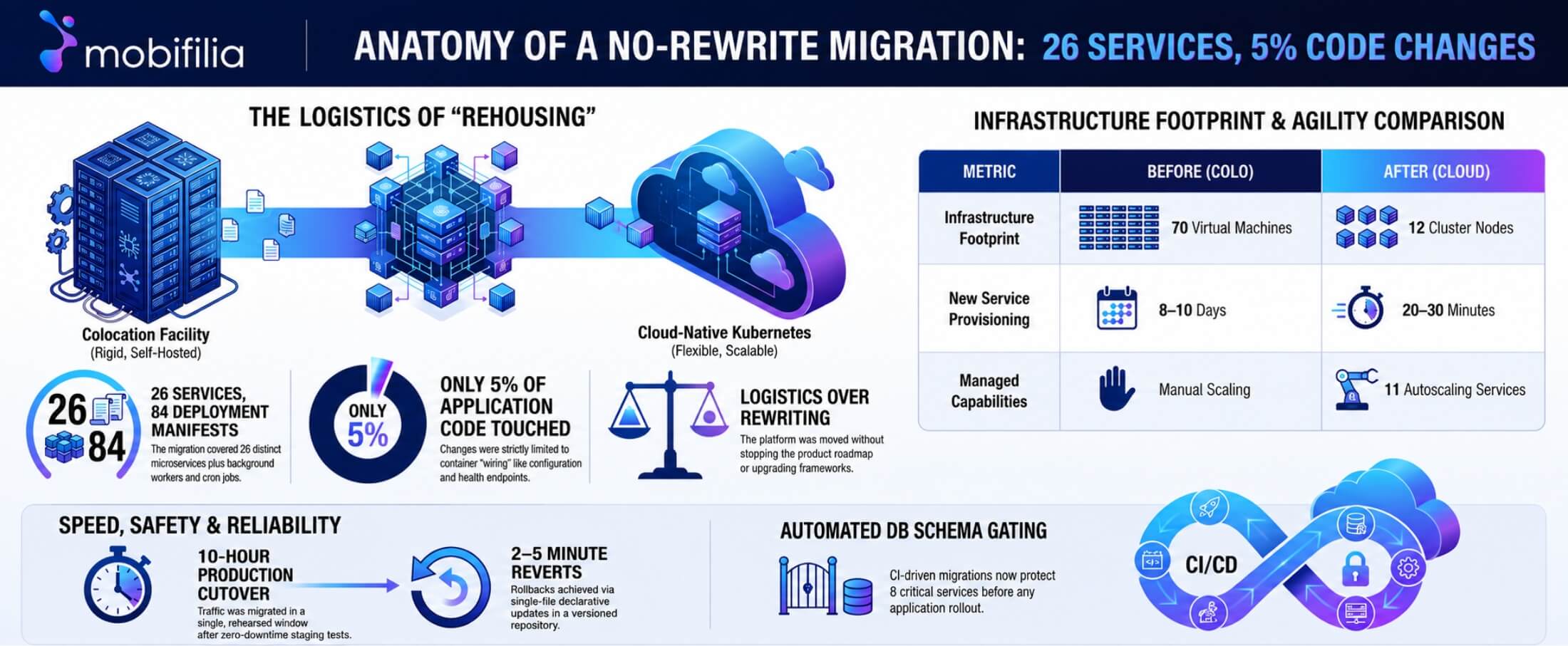
No-Rewrite Cloud Migration: 26 Services, 5% Code Changes
Modernising a Working Product with AI
Hire an AI Team, Not Software: The Agentic AI Playbook
Your AI Agent Is Broken

AI Code Review Bottleneck: Why PRs Slow Down

1 Breach, 3 Security Firms Burned

Your AI Tool Reads Too Much

$2M Risk: One API Ban Can Kill You

Anthropic Stores Every Prompt You Send — And May Be Lying to Yo
Microsoft’s AI Tools Were Hacked. Is Yours Next?

Why Uber Capped AI Coding Tools
Microsoft Build 2026: What Project Solara and AI Agent PCs Mean f

GitHub Copilot Just Got Expensive: Here’s What Smart ISVs A

Every AI Lab Is Now an Agent Lab — Here’s What ISVs Must

Google Says the Age of AI Agents Is Here: What SMB Owners Should

Why Your AI Subscriptions Are About to Blow Up Your Budget (And W

Building an AI Team for the Shop Floor

Why Zero Data Retention Will Make or Break Your AI Development St

Why Zero Data Retention Will Make or Break Your AI Development St

Claude Code Source Leak Reveals the Secret Architecture Behind AI

Supply Chain Attacks Are Exploding: How AI-Powered Security Scann

Gemma 4 vs Microsoft’s New Models: Which AI Stack Will Win the

Why Your Startup Is Overpaying 300% for AI (And How to Fix It)

Why the LiteLLM Supply Chain Attack Changes Everything for AI Dev
EdTech Development: Creating Engaging Learning Platforms

Integrating Multiple Systems? How Custom Software Can Break Down

Staff Augmentation vs Project Outsourcing: Which Model Fits Your

Building an App? 5 Mistakes to Avoid in the Early Stages

DevOps in Custom Software: Accelerating Delivery and Quality —

UI/UX Best Practices for Custom Web Applications — What They Re
Mobile App Development Trends 2026: AI, IoT, and Beyond

Why Choosing the Right Tech Stack Matters

MVP Development: Focusing on Core Features for Success — and Ho

Inbox Under Threat: How Human Verification Can Protect Email From

How to Enhance User Engagement with These Mobile App UX Hacks

10 Signs Your Business Needs Custom Software (And Not Off-the-She

From Concept to Creation: Understanding Product Engineering Servi

Save Time and Money with Effective Prototyping in Software Projec

Securing Your Application: Best Practices from Day 1

Why Custom Software Is a Smart Investment for SMBs

Custom Software for Healthcare: Innovations That Meet Compliance

FinTech Software Development: Security and Compliance Best Practi

Understanding HIPAA Compliance in Healthcare App Development: A C

Breaking the Fix-It Loop – Why Patching Alone Slows Growth

Why ‘Technical Feasibility’ is Crucial Before Buildin

Can AI Replace Designers? The Real Impact on Creative Design Team

Redesigning Hiring for the Underserved – A Blueprint for Talent

Agile vs Waterfall: How to Decide the Best Fit for Your Project

Web App vs Mobile App: How to Choose the Right Platform for Your

Behavioral Traits – The Hidden Engine of Retention

Building Custom Software on a Budget: Expert Advice for Startups

UX as Emotional Infrastructure

Mock Interviews, Real Confidence: Preparing Beyond the Resume

Rapid Prototyping: How AI is Revolutionizing the Design Process i

What If Job Matching Measured Mindsets, Not Just Degrees?

Why Job Boards Fail in Developing Economies

Transforming Software: How AI is Making It More User-Friendly and

Leave Management System – Admin & HR Controls

When Code Bows to Culture

The Role of AI in Super High Paced Development: Transforming the

Who is Soham Parekh?

Leave Management System – Instant Leave Decisions

Leave Management System – Employee Leave Flow

AI-Based Error Log Analyzer: A Smarter Way to Handle Infrastructu

Why Pictures (and Sounds) Speak Louder Than Tables

Leave Management System – Mobile First

Leave Management System – Real Cost
Leave Management System

Keeping Workers Safe: How Computer Vision Revolutionizes Industri

The AI Whisperer: Unmasking Public Opinion with Sentiment Analysi

EHR Interoperability: Enhancing Care Coordination

EHR Security Best Practices: Safeguarding Patient Data

The Benefits of Implementing EHR Systems in Healthcare

Big Data Trends in Healthcare

Business Intelligence for Healthcare Industry
How Mobile Apps Are Transforming Healthcare
Practical Use Cases of RPA in the Healthcare Industry
Google Core Update January 2020
Health Information Exchange (HIE): A Primer

How Wearables are Helping to Monitor Patients
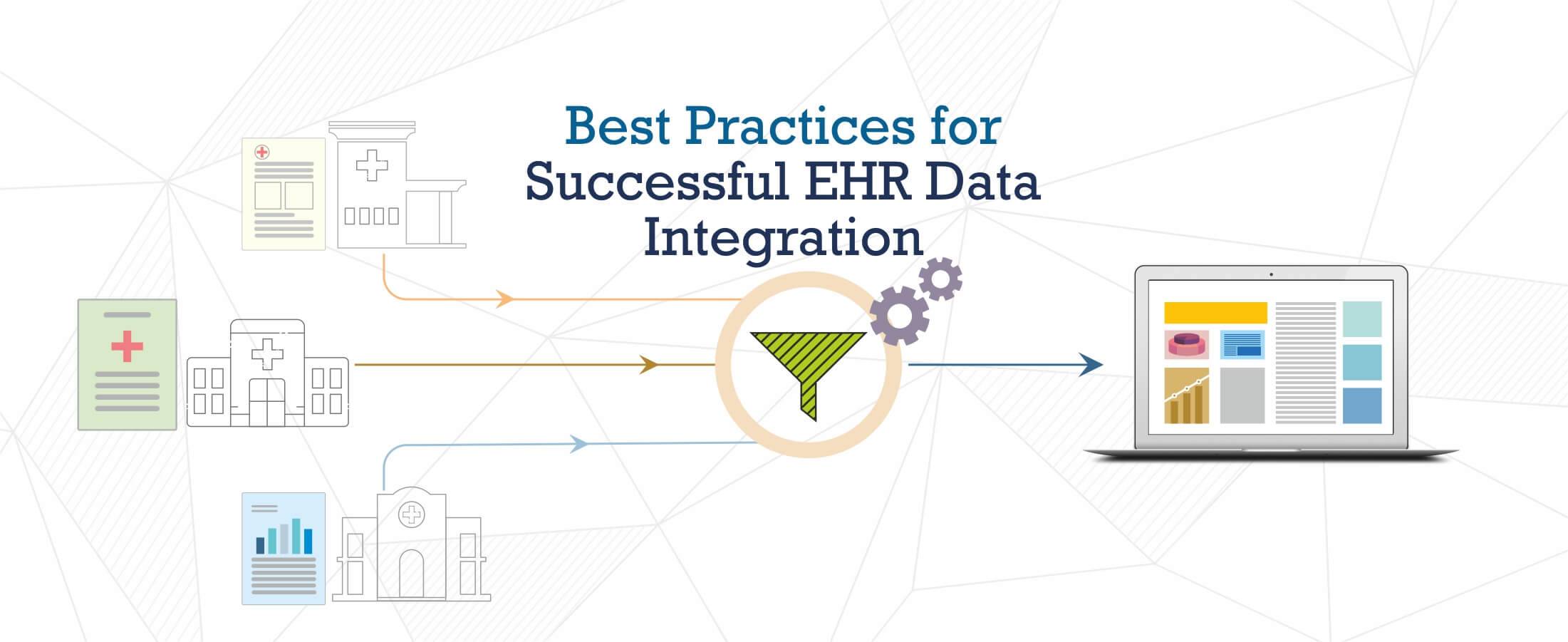
Best Practices for Successful EHR Data Integration
Importance of Sustainable Last-Mile Delivery Options in Building

Applications of 3D Printing in Healthcare

Application and Advantages of Artificial Intelligence and Machine
What is Technical SEO?

Healthcare Tech Space Review 2019
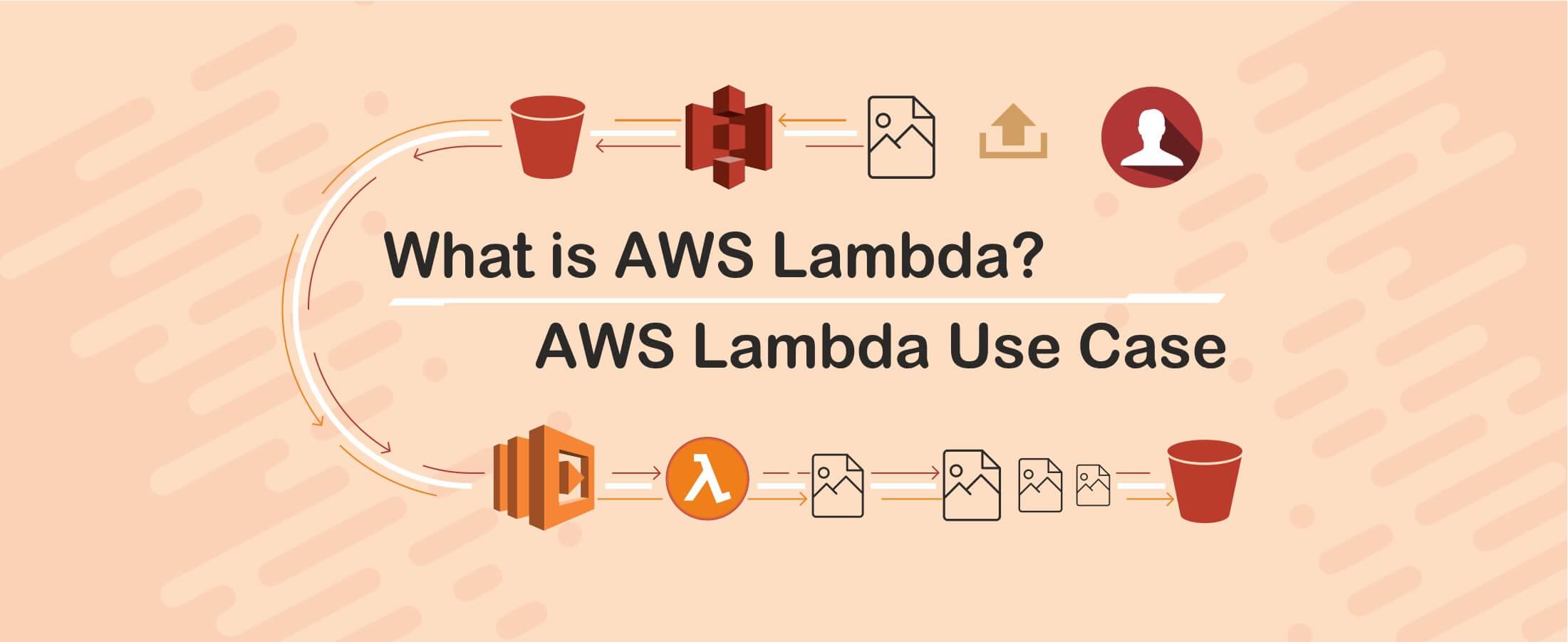
What is AWS Lambda? & AWS Lambda Use Case
Digital Marketing Strategies for Real Estate Agents

Web API and HL7 FHIR – The Future of Interoperability

Why FHIR is Better?

Real Estate Tech Space Review 2019

Improving Patient Care with Chronic Care Management
10 Healthcare Tech Trends to Follow in 2020

10 Real Estate Tech Trends to Follow in 2020
iBuyer: Disruptive Business Model or a Passing Fad?

Symptom Checker: Your personal mhealth app

Facebook for Real Estate Marketing
Use cases for Big Data in Real Estate
Can Real Estate be Uberized?
Using Predictive Analysis for Better Management of Patient Emerge
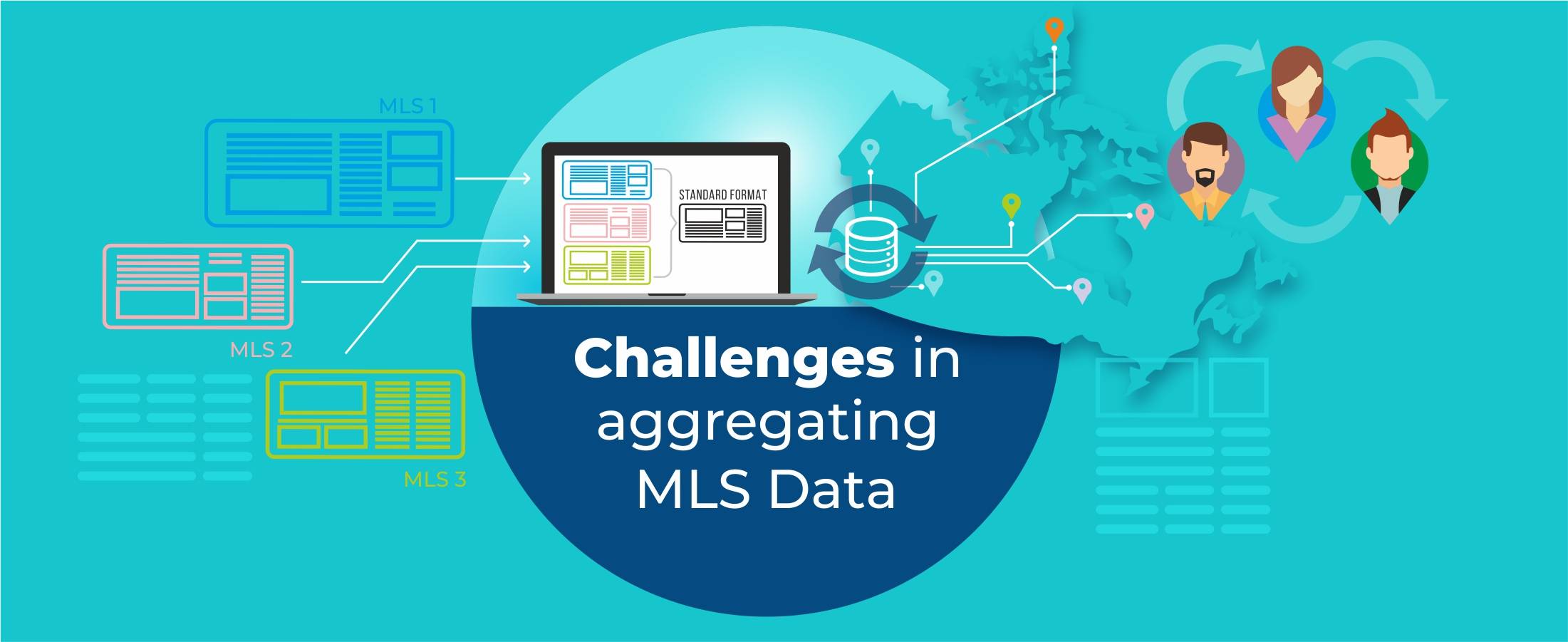
Challenges in Aggregating MLS Data
Home Navigation for the Visually Challenged

Uberization of Healthcare
Using mHealth for monitoring symptoms in children
Pinterest for Real Estate Marketing

Advancement of Voice Inputs over Text in Healthcare

Instagram for Real Estate Marketing
Chatbots in Healthcare
Why brokers are moving to custom solutions rather than using gene
Virtual Hospitals: Future of Healthcare

What Happens in Vegas, Stays in Vegas – Well, not if you ha
8 Healthcare Tech Trends to watch out for in 2019

6 Reasons Why Telemedicine Hasn’t Taken Off

5 Real Estate Tech Trends to watch out for in 2019
How MLS APIs Can Improve Your IDX Performance
How can Realtors generate quality leads using Social Media?
What is the difference between RETS and RESO Web API?
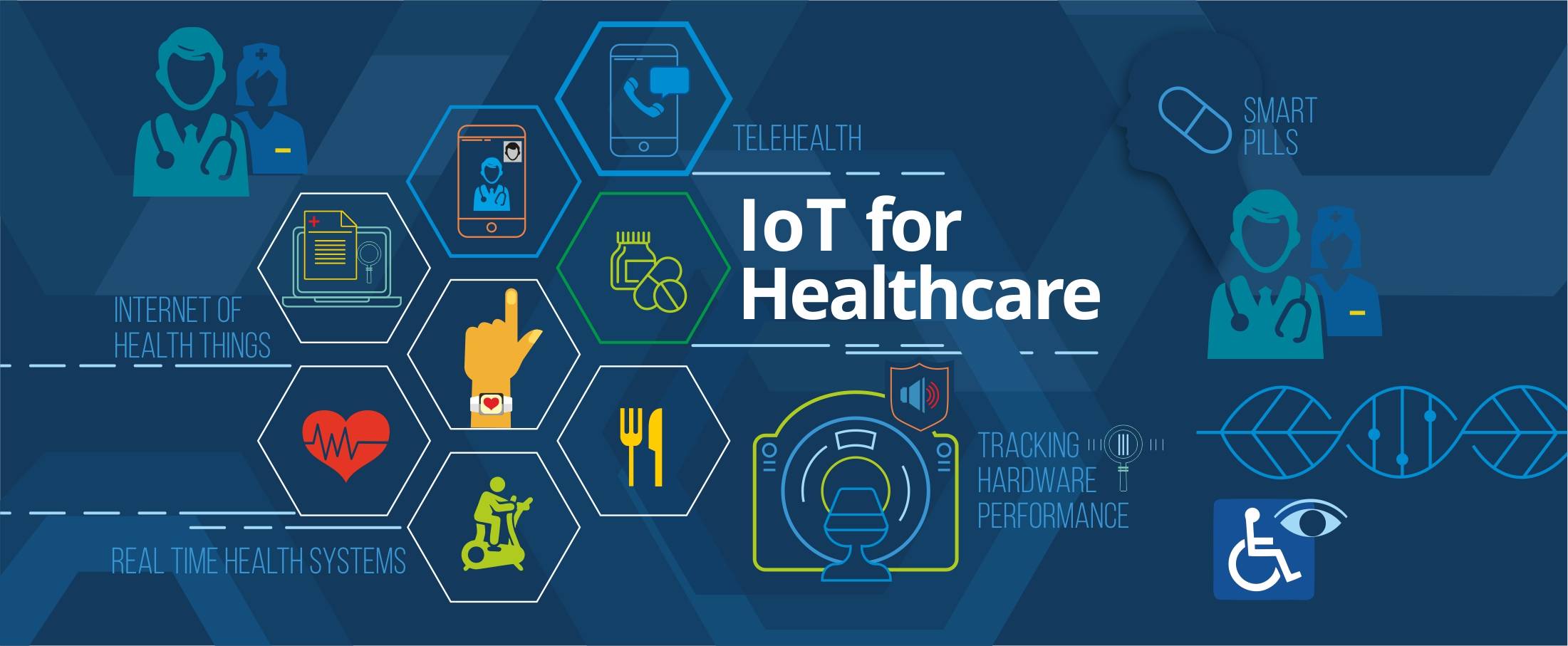
IoT for Healthcare

3D Home Tours – A must have in today’s world?

3D Printing in Real Estate

Pros & Cons of integrating RETS in your website

Blockchain: Opportunities for Healthcare

Pros & Cons of Integrating IDX in your Website

4 Reasons why you need to integrate RESO compliant MLS
Docker Selenium Grid for Parallel Test Execution
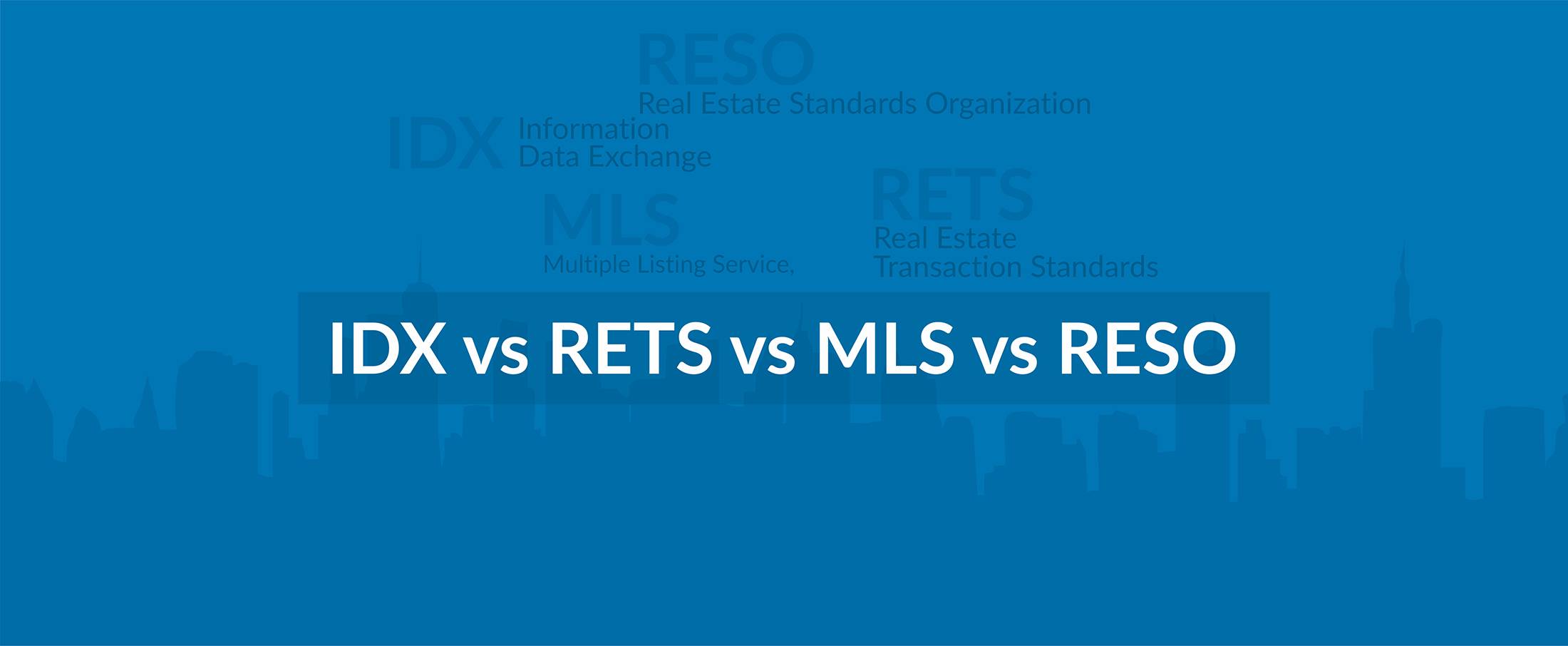
IDX vs RETS vs MLS vs RESO

How is AI Transforming Healthcare
The Future of Virtual Reality in Healthcare

Smart Contracts in Real Estate using Blockchain

How To Choose The Right CRM For Your Business

Best UX Design Practices for Healthcare Applications
FHIR Integration for Better Patient Engagement
IoT for SMART Real Estate
AI to Automate Pre-Showing Process

Best Practices for Healthcare Data Governance

Will Virtual Reality in Real Estate Replace Property Showing?

A Secure Web is Here

Will Uber-ized Property Showing Gain Momentum?

Future of Cloud Computing in Healthcare

5 Real Estate Tech Predictions for 2018

Key Takeaways From Inman Connect NYC 2018 #ICNY
DevOps is the future of the software development
9 Proven Ways to Optimize Google Page Speed

3 Ways to Generate More Real Estate Sales Leads
Introduction to Elasticsearch
5 Real Estate Tasks to Automate
MLS Data: Roadblock for RealTech?

Part II – Writing Better, Faster and Easy to Maintain Mobil
Meteor Security Checks

3 Reasons Why You Need App Prototype For Your Idea

Apple Events September 2017

Part I – Writing Better, Faster and Easy to Maintain Mobile